Archived case 80 · December 17-December 24, 2010
Metallic Mercury Embolism
Clinical History Withheld
The question posed to readers
What are the pertinent radiologic findings and what is your leading diagnosis?
Archived case 80 · December 17-December 24, 2010
Clinical History Withheld
What are the pertinent radiologic findings and what is your leading diagnosis?
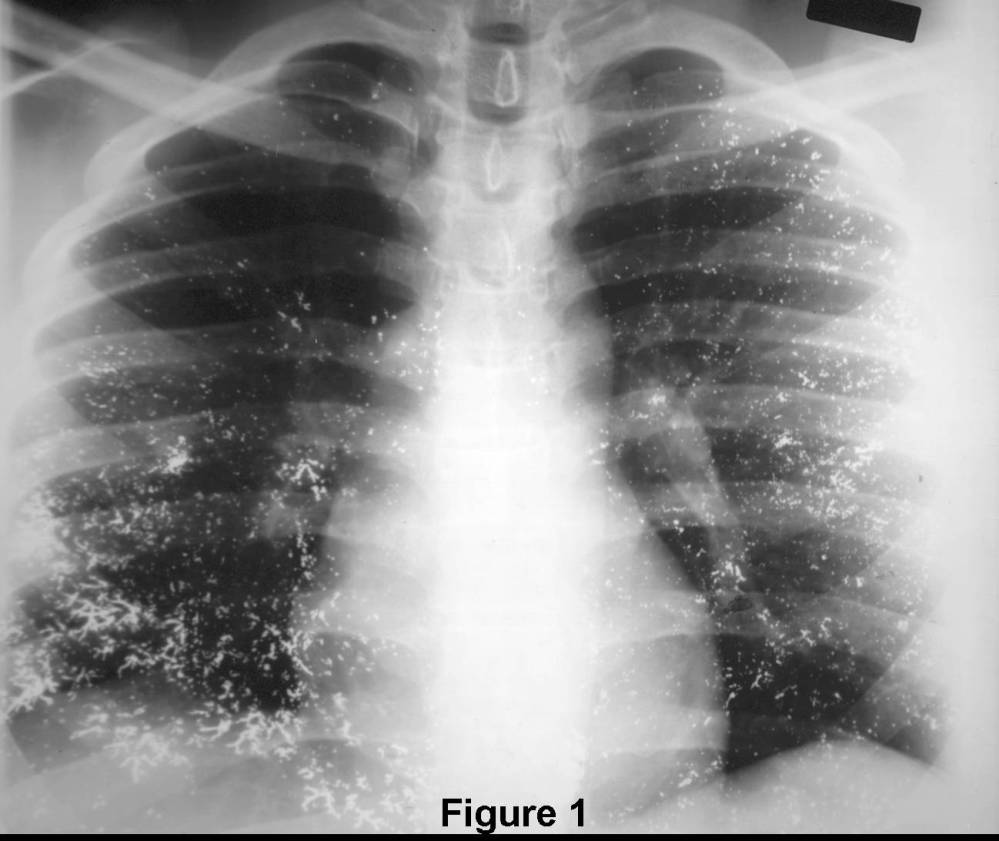


Clinical History: Young man withdrew metallic mercury from more than 30 broken thermometers and intravenously injected the material in a suicide attempt (originally withheld) Radiologic Findings: PA (Fig. 1) chest radiograph reveals a multitude of short linear and branching opacities of metallic density, greater than that of the cortical margins of the ribs, extending far out into the periphery of the lungs and more heavily concentrated in the more dependent lower lung zones. Single view of the left forearm (Fig. 2) shows a linear pattern of deposition of the heavy metal in the soft tissues of the forearm at the injection site. Answer Diagnosis: Metallic Mercury Embolism
Metallic Mercury Embolism
Answer
Diagnosis: Metallic Mercury Embolism
Differential Diagnosis
None
Discussion
The pulmonary embolization of mercury may occur accidentally (e.g., injury from a broken thermometer; venous blood sampling with mercury-sealed syringes) or intentionally after injection by intravenous drug abusers (IVDA) and persons attempting suicide. Self injection of elemental mercury has also been described as a means of improving sexual or athletic performance. Although mercury is relatively viscous in nature, the intravenous injection of mercury readily flows through the veins and is carried to the right heart and then onto the distal pulmonary arterial circuit.
Clinical Findings
Metallic mercury pulmonary embolization may manifest clinically by a metallic taste, gingivitis, excessive salivation, stomatitis, diarrhea, nephrosis, tremor, irritability, excitability, memory loss, and other mental status changes (The Alice in Wonderland’s “Mad Hatter” syndrome). The symptoms are believed to be related to the oxidation of metallic mercury to its more soluble mercuric ion. Pulmonary symptoms may be absent or mild. The mercury deposition in the pulmonary arterial circuit may persist for years after the initial event.
Imaging Findings
Chest Radiography
KUB (Kidney, Ureter, Bladder Conventional Radiograph)
Forearm Radiography (IVDA / Suicide Attempts / Self-Injection)
Treatment
Prognosis
Selected Readings
(Click for a larger image.)
Original case written by its authors at Virginia Commonwealth University and published at this address as part of a weekly teaching collection. Reproduced here as an archive.